YeLu HongJi
Demi-Gods and Semi-DevilsYeLu HongJi is the emperor of the Liao Empire and Xiao Feng’s sworn brother, a ruler whose personal gratitude and political authority repeatedly pull in different directions. His reign is secured by a succession marked by an earlier act of fraternal loyalty, but a later rebellion by his uncle’s faction exposes the fragility of that settlement. When Xiao Feng helps him survive the crisis, HongJi rewards him with the unprecedented title of Prince of Chu and the command of the Southern Chancellery—an honor that also places Xiao Feng in the machinery of a war he does not wish to wage.
Identity and Succession
HongJi’s connection with Xiao Feng begins before the emperor’s identity is known. Xiao Feng encounters the man as YeLu Ji, his sworn brother, and is summoned to meet him by a cavalry attendant who reports that his lord misses him. The reunion takes place amid the Liao court’s armed splendor: soldiers acclaim their ruler, and HongJi reveals that he is the reigning emperor and that his full name is YeLu HongJi. He recalls that Xiao Feng once saved his life and says he will never forget the debt. Xiao Feng, startled by the revelation, kneels in deference, but HongJi raises him and insists that their brotherhood should take precedence for the day; formal obeisance can wait until the next.
The history behind HongJi’s throne helps explain the danger that later confronts him. His grandfather, YeLu LongXu, designated his eldest son YeLu ZongZhen as successor, although the empress favored her second son, YeLu ZhongYuan, a capable military leader. The mother’s attempt to elevate ZhongYuan was thwarted when ZongZhen confided the scheme to his brother. In gratitude, ZongZhen named ZhongYuan the royal emperor brother and placed him next in line. Yet after ZongZhen’s death, the throne passed not to ZhongYuan but to ZongZhen’s son HongJi. HongJi later tried to acknowledge his uncle’s standing: he granted ZhongYuan the title of royal emperor uncle, restored him as heir presumptive, gave him supreme command of the army, exempted him from kneeling at court, and bestowed other privileges. He also made ZhongYuan’s son YeLu NieLuGu Prince of Chu and gave him control of military affairs in the Southern Chancellery. These concessions left the emperor’s uncle and cousin exceptionally powerful.
The arrangement had seemed grounded in loyalty. ZhongYuan had earlier declined the throne, despite the Dowager’s support, and helped his brother instead; the account presents his silence about the attempted succession scheme as further evidence of his allegiance. HongJi likewise trusted him enough to leave him in charge of military affairs while the emperor went hunting. That trust becomes the fault line of the crisis: the rebellion is led by NieLuGu, but the emperor fears his uncle may be complicit or unwilling to stop his son.
The Emperor and Xiao Feng
The revelation of HongJi’s identity changes neither man’s sense of their bond nor the political imbalance between them. At their first reunion as emperor and subject, HongJi refuses to let Xiao Feng’s ignorance of his rank count as an offense. He welcomes him into the great leather tent and seats him opposite the throne, while civil and military officials file in to pay their respects. The formal court setting makes their private familiarity conspicuous: HongJi holds Xiao Feng’s hands and greets him as a brother even as the assembled army recognizes him as sovereign.
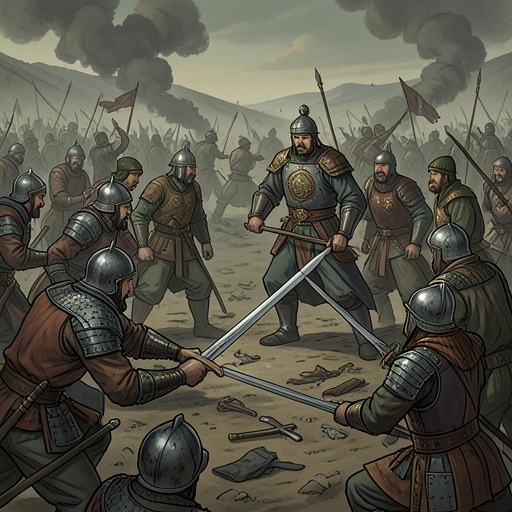
When the rebellion breaks out, HongJi’s response combines composure with mounting peril. The news reaches the hunting camp through a chain of bugle signals; after the alert spreads, the emperor calmly finishes his wine and orders an immediate return to the capital. Reports soon clarify the scale of the threat. NieLuGu has proclaimed ZhongYuan emperor and issued an edict branding HongJi a false ruler who usurped the throne. HongJi burns the edict, but understands that its claim could unsettle the army and that his uncle, as supreme commander, can call on vastly greater forces. With about 100,000 troops at his side against a potential 800,000, he spends the night unable to sleep.
Xiao Feng considers leaving rather than accepting an imperial post, but the danger to his sworn brother makes departure difficult. He hears soldiers crying over the families they believe to be held hostage in the capital, and sees how fear is breaking the army’s spirit. The following morning, HongJi confronts the advancing force with his own troops. He promises promotion and substantial rewards once the crisis is resolved, dons golden armor and a helmet, and personally leads the column. His visible presence restores some courage: the soldiers cheer and pledge to fight beside him. Xiao Feng rides at HongJi’s side as his personal bodyguard, while the Flying Bear troops protect A'Zi behind the army.
Rebellion and Restoration
The conflict is not simply a contest of numbers. The rebels’ proclamation attacks HongJi’s legitimacy by presenting ZhongYuan as the rightful emperor, turning the earlier succession settlement into a weapon against the reigning sovereign. HongJi’s smaller force faces the risk of wavering allegiance as well as military defeat. His personal leadership helps rally the troops, but the crisis is resolved decisively when Xiao Feng captures ZhongYuan and brings him before the emperor. With the royal emperor uncle in custody and the Prince of Chu dead, the rebel soldiers lose their immediate leadership and lay down their weapons.
HongJi greets Xiao Feng with visible relief, takes both his hands, and declares that he will share his country with him. The captured ZhongYuan kneels and asks for mercy. Rather than urge punishment, Xiao Feng advises that the immediate need is to settle the army and restore its morale; he asks HongJi to pardon his uncle so the soldiers can feel secure. HongJi accepts the counsel. The episode shows him exercising authority through clemency, but also reveals how much he trusts Xiao Feng’s judgment at the very moment his throne has been rescued by it.
HongJi then appoints Xiao Feng Prince of Chu and Lord of the Southern Chancellery, ordering him to take charge of the rebel army and return to the capital. Xiao Feng is shocked: he had fought to preserve his friend, not to gain rank, and says he neither knows how to serve as an official nor wants the appointment. HongJi answers with extravagant affection, saying that if this highest office in the Liao Empire is still insufficient to persuade his brother, he could surrender the throne itself. The offer underscores the depth of his gratitude, but it also folds a private bond into public power. Xiao Feng eventually accepts the command, and after the rewards are distributed he takes up the work of the Southern Chancellery.
Rule, Frontier, and the Southern Command
The office HongJi gives Xiao Feng brings him into the political economy of the frontier. For more than a month, Xiao Feng is occupied receiving tribal chiefs, military officers, palace officials, and envoys from the many polities associated with the Liao Empire. Their gifts and praise surround the new commander with the signs of power, but HongJi soon gives the appointment a more consequential purpose: Xiao Feng is to be based in Nanjing and await an opportunity to conquer the Song. HongJi says that the empire needs time to recover from the rebellion and that the Song, governed by its Empress Dowager and relying on Sima Guang in state affairs, offers no weakness worth exploiting immediately. Xiao Feng is nevertheless instructed to keep the southern conquest in mind and to act if internal disorder creates an opening.
HongJi’s plan draws on a longer history of strategic advantage. Nanjing, also called Yanjing, lies within the territories ceded to Liao after Shi JingTang declared himself emperor and received Liao support. The account describes the sixteen prefectures as strategically placed: they allow Liao forces to push deep into Song territory, while the Song lacks equivalent defensive positions. It is this geography, rather than a simple difference in soldiers or equipment, that is identified as the source of Liao’s military advantage in the long conflict between the states. HongJi’s intended southern campaign therefore rests on an inherited territorial arrangement as well as on his own ambitions for the empire.
Xiao Feng accepts the order but is troubled by its implications. Though a citizen of Liao, he grew up in the south and is reluctant to lead an invasion of the Song. He tells himself that refusing immediately would dishonor the brotherhood that HongJi has rewarded so lavishly; he plans to serve for a time in Nanjing and seek resignation later, leaving if the emperor will not release him. His unease sharpens when he sees the human cost of Liao’s frontier raids. A returning force brings hundreds of Song captives, mostly young women, alongside goods taken in a raid. Xiao Feng recognizes the pattern as reciprocal border violence: Liao’s “Beating The Grass Valley” supplies its troops by plundering neighboring lands, while Song reprisals are called “Beating The Standing Valley.” Civilians near the frontier live under the threat of raids from either side. HongJi’s appointment thus places Xiao Feng between the emperor’s strategy and the suffering that strategy sustains, even as the emperor himself is not shown directing this particular raid.
Political Significance
HongJi’s characterization turns on the tension between personal loyalty and imperial obligation. He is grateful enough to treat Xiao Feng’s friendship as more important than immediate court ceremony, and generous enough to offer him a position never before granted to a non-royal. Yet he also expects that friendship to coexist with service to the state, including preparations for a southern war. The warmth of his bond with Xiao Feng does not dissolve the demands of sovereignty; it makes those demands more intimate and harder for Xiao Feng to refuse.
His reign is also shaped by institutions that outlast individual intentions. The Dowager’s influence over succession, ZongZhen’s designation of an heir, ZhongYuan’s military command, and the strategic legacy of the sixteen prefectures all constrain the choices made in the present. HongJi’s crisis begins when a negotiated family settlement is challenged through an edict and an army; it ends when Xiao Feng’s intervention restores the emperor, but the same restoration elevates Xiao Feng into a role that exposes the violence of imperial policy. HongJi emerges not only as the ruler saved by his sworn brother, but as the sovereign whose reward binds that brother to a state and a war he would rather leave behind.